Instagram Algorithm 2026: Everything Changed — Here's What Actually Works Now
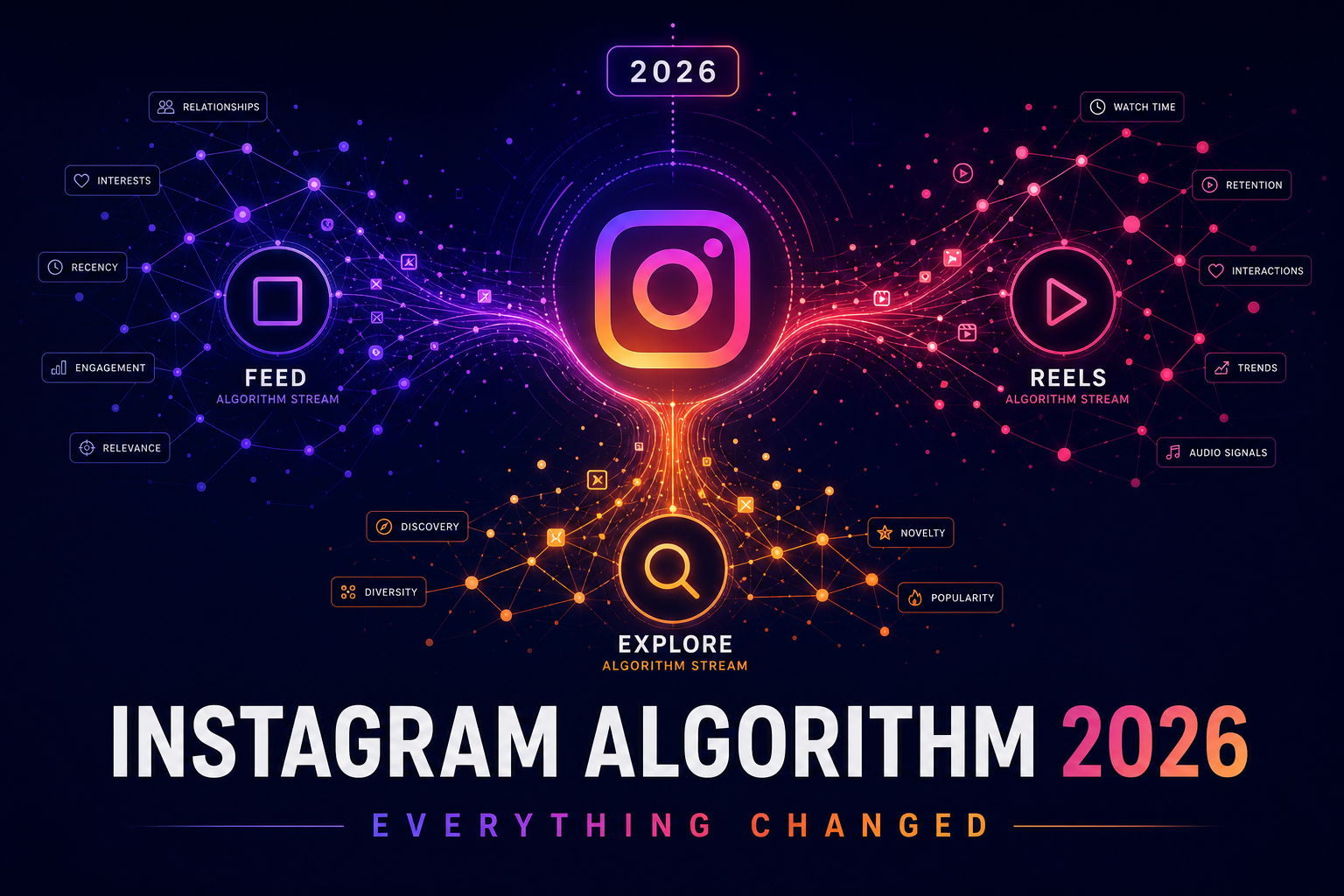
The Instagram algorithm in 2026 is fundamentally different from 2024 — separated ranking systems for Feed, Reels, and Explore, AI-driven topic clustering, and watch-time weighting that changed which content gets pushed. Here''s the practical breakdown of what actually works now.
Every year someone declares "the Instagram algorithm has changed", and every year about 60% of that is recycled hot air. 2026 is different. Between mid-2025 and early 2026 Instagram rolled out three structural shifts that genuinely broke old playbooks: separated ranking systems per surface, AI-driven topic clustering, and a watch-time weighting overhaul that moved the goalposts on what counts as "good" content. If your Reels engagement collapsed without you changing anything, this is why. Here''s the practical breakdown of what works now.
Shift #1: Three separate algorithms, not one
The biggest misconception in 2026 is "the Instagram algorithm". There isn''t one — there are three, with different signals and different optimization paths:
- Feed algorithm — ranks posts among people you already follow. Cares about: post-on-post engagement velocity, dwell time, time-since-posted, your historic interaction with the poster. Optimization is about deepening existing follower relationships.
- Reels algorithm — ranks Reels among non-followers. Cares about: completion rate, watch-time-per-viewer, save and share rate, topical clarity. Optimization is about hooking strangers.
- Explore algorithm — ranks posts and Reels in the discovery grid. Cares about: a blend of the above plus topic relevance to the viewer''s recent search and watch history. Optimization is about clear topic signals.
What works on Reels often fails on Feed and vice-versa. Stop optimizing for "Instagram" — optimize for the specific surface where your content lives.
Shift #2: AI-driven topic clustering replaced hashtags
Hashtags still exist but their ranking weight dropped sharply in 2025 and is near-zero in 2026 for distribution decisions. Instagram now reads your content directly: caption text, on-screen text, audio transcript, visual subjects, and even music sentiment. From those signals it assigns your post to "topic clusters" — micro-categories like "intermediate home workout for women over 30" rather than broad tags like "fitness".
Practical impact: 30 hashtags is dead. 3–5 hyper-specific niche tags + caption-and-text matching the topic cluster you want = far better distribution.
Shift #3: Watch-time-per-viewer beats completion rate
Until 2024, completion rate (% of viewers who watched to the end) was the dominant Reels signal. In 2026, the bigger signal is average watch time per unique viewer. A 12-second Reel with 95% completion now loses to a 35-second Reel with 70% completion if total watch-time-per-viewer is higher.
This rewards depth and punishes throwaway short-form content. Niches that demand depth (education, finance, fitness, business) benefit. Pure-meme accounts have to work harder to keep average length up.
What actually works on Reels in 2026
- 20–45 second Reels with payoff at 70–80% mark. Sweet spot for watch-time-per-viewer.
- Hooks that pay off in 1.5 seconds. Frame 1 must promise something. No logo intros, no "Hey guys".
- Audio in the 5K–80K uses range with rising trend. Saturated audios (>500K) hurt small accounts now.
- Caption + on-screen text + audio transcript matching the same topic cluster. AI clustering rewards consistency across all signals.
- First-60-minute engagement velocity. Reply to every comment, share to Story, share to DMs.
- Saves > likes. Saves are weighted ~3× a like for Reels distribution. Optimize content that''s "save-worthy" (lists, frameworks, tutorials).
What works on Feed in 2026
- Carousel posts (3–7 slides). Highest dwell time of any Feed format. Each slide is a separate dwell signal.
- Caption length 80–250 characters. Long captions kill dwell on the first impression — viewers scroll past. Short with curiosity hook works better in 2026.
- First-hour follower interaction. Replying to follower comments in the first 60 minutes is the strongest Feed boost.
- One main subject per post. AI clustering on Feed needs clarity too.
What works on Explore in 2026
- Topic clarity over creativity. A clean tutorial with one obvious topic outperforms a clever multi-topic Reel.
- Strong save rate. Explore disproportionately surfaces save-magnet content.
- Click-through to profile. Reels that drive profile visits get a second-layer boost on Explore.
What stopped working (or never really worked)
- 30 hashtags. Dilutes topic signal. Cap at 5.
- Engagement pods and like-for-like groups. Detected since 2023, actively penalized in 2026.
- Buying bot followers / bot views. Always backfired, but in 2026 it now signals to AI clustering that your audience is "low-quality" — actively damages topic match for future posts. If you must boost engagement, only use real-tier services from a verified panel (compare on smmcompare.com).
- Cross-posting Reels to Feed and Story simultaneously hoping for triple distribution. Now triggers a duplicate-content discount on Reels.
- "Best time to post" rigid windows. Now individual to your audience — check Insights, not generic blog charts.
The new mental model
Stop thinking "I''m posting to Instagram". Start thinking "I''m posting to Reels for non-follower discovery" or "I''m posting to Feed for follower retention" or "I''m posting to Explore for topic-search visibility". Each surface has its own algorithm, its own signals, and its own winning playbook. Treat them differently.
Bottom line
2026''s Instagram algorithm rewards: clear topic signals, watch-time-per-viewer, first-hour engagement velocity, and surface-specific optimization. It punishes: spammy hashtag stuffing, ultra-short throwaway content, bot engagement, and topical confusion. Spend the next 30 days running one Reels test per day with the six factors above, track which moves the needle, and you''ll have your own playbook for whatever the algorithm does next.