Instagram trending Reels: what the price of a save tells you about the algorithm
A thousand Instagram views cost four tenths of a cent. A thousand saves cost a cent. What that gap says about which signals Reels distribution actually trusts.
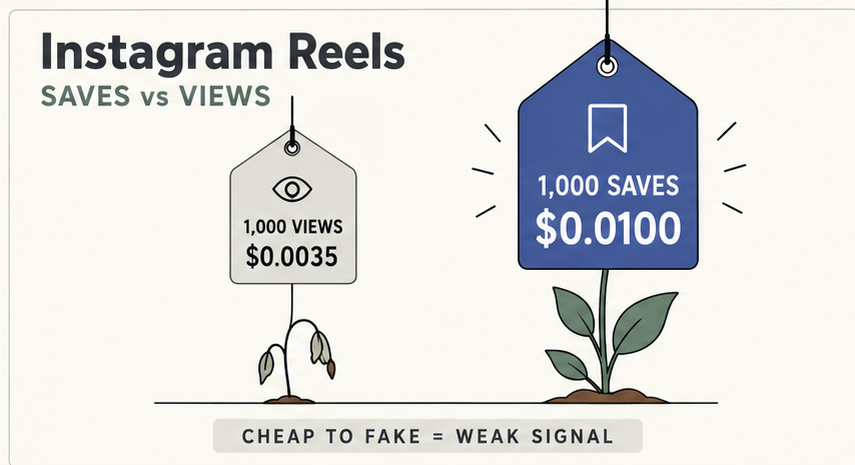
A thousand Instagram views cost about four tenths of a cent on the open panel market. A thousand saves cost about a cent. A thousand shares cost slightly less than that. Those three numbers come from the same 2.6 million service listings we read across roughly 1,900 panels, and the ratio between them says more about how Reels get distributed than most advice on the subject.
Views are the cheapest thing anyone sells. There are 38,430 separate Instagram view services in our index and the cheapest fifth of them start at $0.0035 per thousand. Saves sit at $0.0100 and shares at $0.0090, which means a save costs roughly three times a view. Followers are in a different league again at $0.7706 per thousand, which is more than two hundred times the price of a view.
Why the price gap exists at all
Price on a panel tracks difficulty, not value. A view is a request that loads a video for a second or two. It can be produced at enormous scale with very little, which is why it costs nearly nothing. A save writes to a specific account's collection. A share opens a send sheet and picks a recipient. Both need something closer to a real session on a real account, so supply is thinner and the rate is higher.
Instagram sees the same asymmetry from the other side. A metric that is cheap to manufacture is a weak signal, and a platform that ranks by weak signals ends up promoting junk. The things that are expensive on a panel are expensive because they are hard to fake, and the things that are hard to fake are exactly what a ranking system can afford to trust.
So the panel price list is a rough map of what Instagram can rely on. You do not need internal documentation to work out that saves and sends carry weight. The market has already priced them that way.
What this means for a reel you are actually posting
The practical version is that view count is the metric you should care about least while the reel is young. It moves first, it moves for reasons that have nothing to do with quality, and a reel can collect thousands of views and still stop dead.
Watch the ratio of saves and sends to views instead. A reel with 2,000 views and 60 saves is in better shape than one with 20,000 views and 15 saves, because the first one is telling Instagram that people wanted to keep it. Sends are the strongest of the lot, since sending a video to a friend costs the sender something socially and nothing on the platform can simulate that cheaply.
This also explains the common complaint about reels that stall at a few hundred views. The stall is usually not a penalty. It is the end of the first test audience, and the reel did not produce enough of the expensive signals to earn a second one.
Trending audio is a smaller lever than people think
Using a sound that is currently climbing does help a reel surface in that sound's feed, which is a real distribution channel with real traffic. What it does not do is make a reel worth watching twice. The audio gets you into the room. The first two seconds decide whether anyone stays.
There is also a timing problem with chasing sounds. By the time a sound is visibly trending in the app, the useful part of the curve is often over, and you are competing with everyone else who noticed at the same moment. Audio that is three or four days into its rise tends to work better than audio that is already labelled as trending.
The format that holds up regardless of sound is the one where the first frame states a specific problem the viewer has, in a way that makes the right person think the next six seconds are about them. A shocking claim gets the same job half done, because it stops the scroll without giving anyone a reason to stay.
Where buying fits, if it fits
Most people asking about trending Reels eventually ask whether buying anything helps. The honest answer depends entirely on which metric and what it is for.
Views are cheap enough that buying them changes nothing about distribution. They raise a number on a page. If the goal is social proof on a reel that is going into an ad or a pitch deck, that is a legitimate reason to want the number higher. If the goal is reach, the cheap metric is the one the algorithm trusts least, so it is the one least likely to move anything.
Saves and shares are more interesting precisely because they are more expensive, and also riskier. A reel with 400 views and 300 saves does not look like anything that happens naturally, and a pattern that obvious is the kind a platform can detect without much effort. If you buy them at all, the ratio has to look like a ratio that could exist.
Followers are the most expensive of the four and the least connected to how a single reel performs. A follower who never watches your videos lowers the percentage of your audience that engages, which is the opposite of what you want on a page you intend to post on regularly.
Checking a price before you pay it
Rates on these services move constantly and vary wildly between panels selling the same thing. The floor figures above are the cheapest fifth of the market, not what a given panel will quote you. We have seen the same nominal Instagram view service priced at twenty times the market rate on a panel that was simply not competing on price.
Before you buy any of these, look up the service on SMMCompare and compare it against the same platform, action, geo and refill terms elsewhere. A fifteen second check is worth it on a service where the spread between the cheapest and most expensive listing is routinely an order of magnitude.