Spotify plays, saves and followers: what each one costs in 2026
90,635 panels sell Spotify plays from $0.1706 per thousand, while monthly listeners start near $0.99. Why listeners cost five times a play, and what moves a track.
Spotify is the second most listed platform in our index after Instagram. There are 90,635 separate services selling Spotify plays across roughly 1,900 panels, which is more than the number selling Instagram likes. The cheapest fifth of those play services start at $0.1706 per thousand.
That one number tends to surprise people who come from Instagram pricing, where a thousand views costs a fraction of a cent. A Spotify play costs about fifty times an Instagram view. Everything about promoting music on these panels follows from that difference.
What each Spotify metric costs
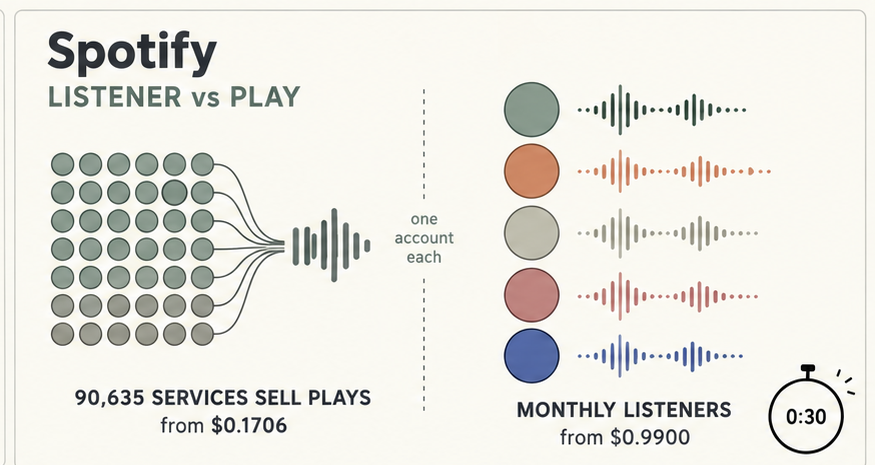
Plays start at $0.1706 per thousand. Followers start at $0.2079. Saves start at $0.2280. Monthly listeners are the outlier at $0.9900, nearly six times the price of a play, with only 4,707 services selling them compared to the 90,635 selling plays.
The ordering is worth sitting with. On most platforms the follower is the expensive item and the view is nearly free. On Spotify the gap between a play and a follower is small, and the genuinely expensive thing is a listener.
Why a listener costs five times a play
A play is one stream of one track. A monthly listener is a unique account that streamed you inside a rolling thirty day window, and it only counts once no matter how many times that account listens. You cannot manufacture listeners by replaying a track. You need a different account for each one.
Accounts are the scarce resource. A panel selling plays can route a lot of volume through a comparatively small pool of accounts. A panel selling listeners has to spend a fresh account for every unit it delivers, and that account has to look like a listener rather than a bot, because Spotify audits this directly and strips streams it does not believe.
This is also why the play to listener ratio on a track matters to anyone looking at it seriously. Ten thousand plays from four hundred listeners is a different story from ten thousand plays from six thousand listeners, and the second one is considerably more expensive to fake.
What actually moves a track
Playlist placement is the mechanism everything else feeds into. Spotify's editorial and algorithmic playlists look at completion rate, saves, and whether listeners return, and the strongest of those is the save. A save is a listener telling Spotify they want this track in their own library, which is the same signal structure as a save on Instagram and for the same reason: it costs the listener something and it cannot be produced by volume alone.
Completion rate is the one most artists ignore and the one most worth fixing before spending any money on promotion. A track that loses half its listeners in the first twenty seconds will not hold a playlist slot regardless of how many plays arrive. Streams that stop early tell Spotify the recommendation was wrong, and the system stops making it.
No panel sells completion rate, because it depends on the track rather than the traffic. You can buy the arrival and nothing that happens in the thirty seconds afterwards.
The thirty second line
Spotify counts a stream for royalty purposes after thirty seconds of play. Services that deliver shorter plays therefore cost less and are worth less, and the listing rarely says which kind you are getting.
If a play service is priced well under the market floor, the first thing to check is play duration. A service at a third of the going rate is usually delivering something shorter than thirty seconds, which means it inflates a number on your artist page and pays nothing. Panels that deliver full streams generally say so in the description, because it is the thing they are charging extra for.
Ask directly if the listing is silent. A panel that cannot answer how long its plays run is telling you something.
Geo matters more here than on most platforms
Royalty rates per stream differ by country, and so do playlist audiences. A track with ten thousand plays spread across countries with no relationship to each other looks like what it is, and Spotify's recommendation system has nothing coherent to work with when deciding who else to play it to.
Geo targeted Spotify services exist and cost more than untargeted ones. If you are promoting a track with a specific audience in mind, that premium buys you something real. If you are buying plays purely for the number on the page, the cheapest worldwide service does the same job for less, and does the same amount of nothing for your actual growth.
Before you buy
The spread between panels on identical Spotify services is wide. We regularly see the same service type listed at five or ten times the market floor on panels that are not competing on price, and buyers pay it because they have nothing to compare against.
Look the service up on SMMCompare first, and compare like with like: plays against plays, with the same geo and the same order minimum. The minimum matters as much as the rate when you are testing a track, because a cheap service with a twenty thousand unit floor is not cheap for a single release.