Comments are the most expensive thing to fake on every platform
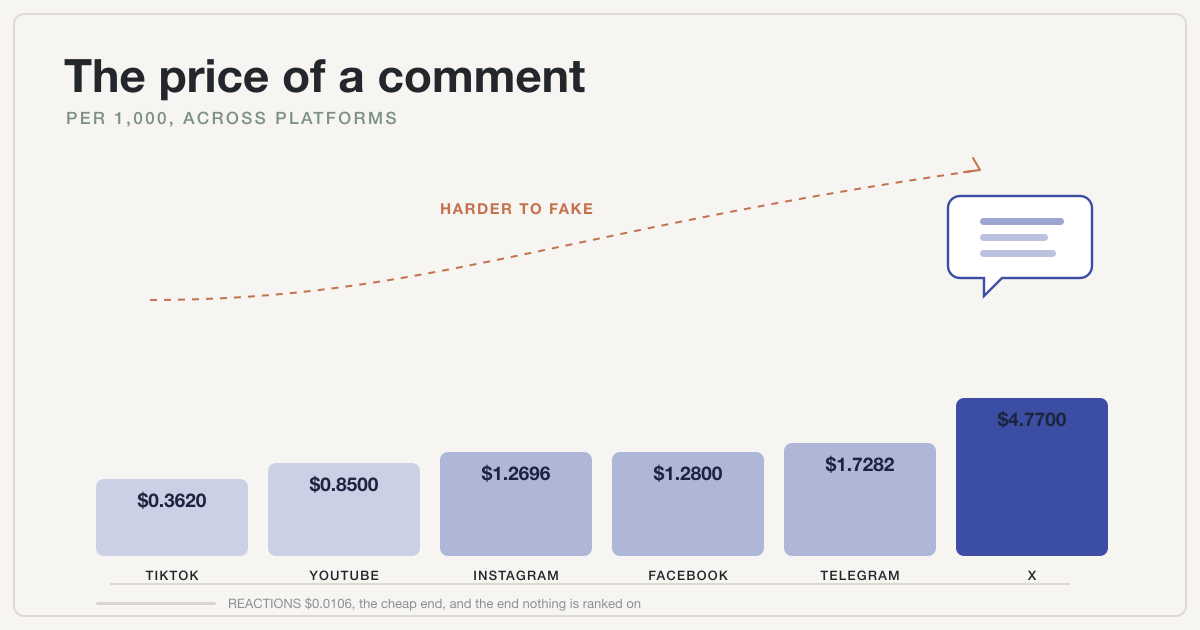
Comments run from $0.3620 per thousand on TikTok to $4.7700 on X, while views and reactions cost almost nothing. The price list is an accidental map of what each algorithm trusts.
On every platform we index, the comment is among the most expensive things you can buy. A thousand comments on X start at $4.7700. On Telegram $1.7282. On Facebook $1.2800, Instagram $1.2696, YouTube $0.8500, TikTok $0.3620.
Compare that to the cheap end of the same platforms. A thousand TikTok saves start at $0.0070. A thousand Telegram reactions at $0.0106. A thousand TikTok video views at $0.0074. The spread between the cheapest metric and the comment is three orders of magnitude on some platforms.
Prices are the 5th percentile across roughly 1,900 panels, so they are the floor of a competitive market rather than one panel's quote.
What makes a comment expensive
A comment needs an account that can post, which is a higher bar than an account that can click. Platforms restrict commenting from new, unverified, or low-trust accounts long before they restrict liking.
A comment needs text, and text that is not identical to the last four hundred comments the same provider delivered. Random-tier services solve this with a rotating pool of generic lines, which is why random comments cost a fraction of custom ones.
A comment is visible and permanent. A fake like disappears into a number. A fake comment sits under the post where every reader and every moderation system can see it, so providers lose accounts faster delivering them.
The price list is a map of what platforms trust
This is the part worth taking away. Platform ranking systems weight signals roughly in proportion to how hard they are to manufacture, because a system that ranked on cheap signals would be gamed into uselessness within a week.
So the panel price list is an accidental map of algorithmic weight. The things that cost nothing to buy are the things that count for little: views, reactions, impressions. The things that cost real money are the things that count: comments, saves on platforms that weight them, watch time, live concurrency.
You can read it in either direction. If you want to know what to work on organically, look at what is expensive on the panels. If you want to know what a bought number proves, look at what it cost.
YouTube is the exception worth noticing
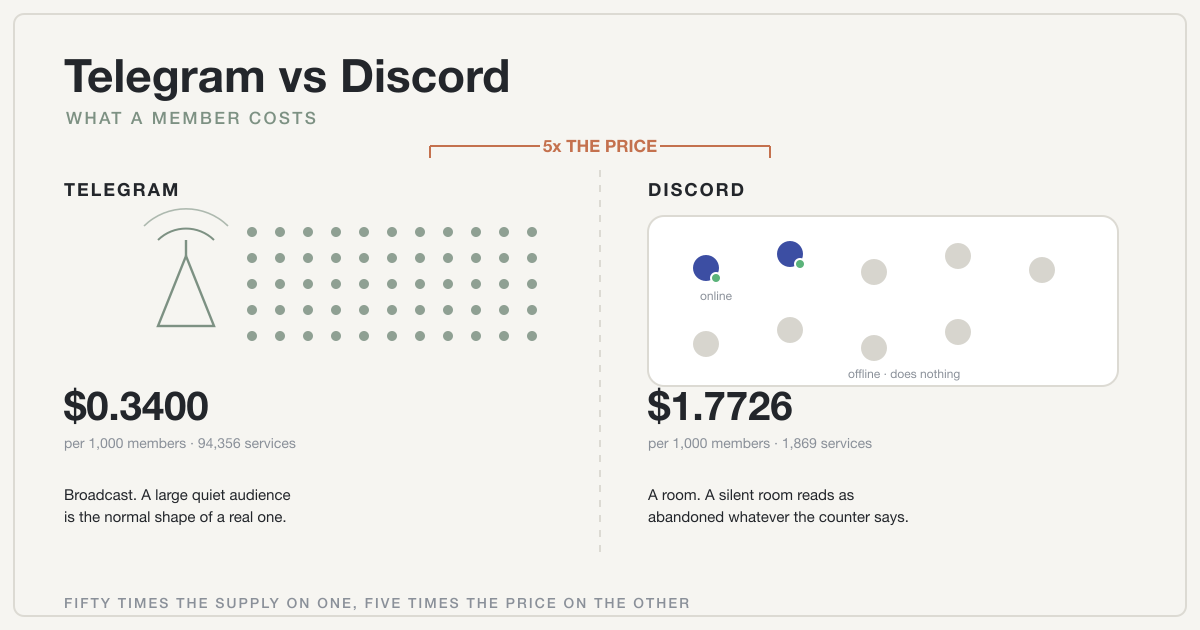
YouTube views start at $0.7200 per thousand. TikTok views start at $0.0300 and TikTok video views at $0.0074. The same nominal product costs 24 to 97 times more on YouTube.
YouTube counts a view only after a sustained watch, audits retention afterwards, and removes counts it does not believe, sometimes days later. Delivering a YouTube view means holding a session, not firing a request. The price difference is the cost of that difference.
It also means a YouTube view count is worth more as evidence than a TikTok view count, not because YouTube is more honest but because faking it is more expensive. The same logic puts YouTube comments at $0.8500, below Instagram and Facebook, since YouTube comment accounts are easier to source than Instagram ones.
What this means if you are buying
The instinct is to buy the cheap thing, because the number gets large and the invoice stays small. A million TikTok video views for about seven dollars is a real offer.
The problem is that ratios are what people and systems read. A post with a huge view count and almost no comments is legible to everyone, including the platform. The cheap purchase creates the exact pattern that marks a post as inflated, and it does it precisely because it was cheap enough to buy in quantity.
If you buy anything, buying less of the expensive metric produces a more plausible post than buying more of the cheap one. A hundred comments cost roughly what a hundred thousand views cost on most platforms, and the hundred comments are what makes a post look like people were there.
What this means if you are measuring
If you are evaluating a creator, a channel, or a panel's own claims, price the metrics you are being shown. Ask what it would have cost to fake the number in front of you.
A channel showing 400,000 views and 11 comments is showing you about twelve dollars of views. A channel showing 20,000 views and 300 comments is showing you something that would have cost more to fake than it was probably worth. That is not proof, but it is a better filter than looking at the big number.
Rates move constantly and vary enormously between panels. Every figure here is the market floor, and plenty of panels quote several times it for the identical service. If you want to check what something should cost before you pay for it, look it up on SMMCompare.